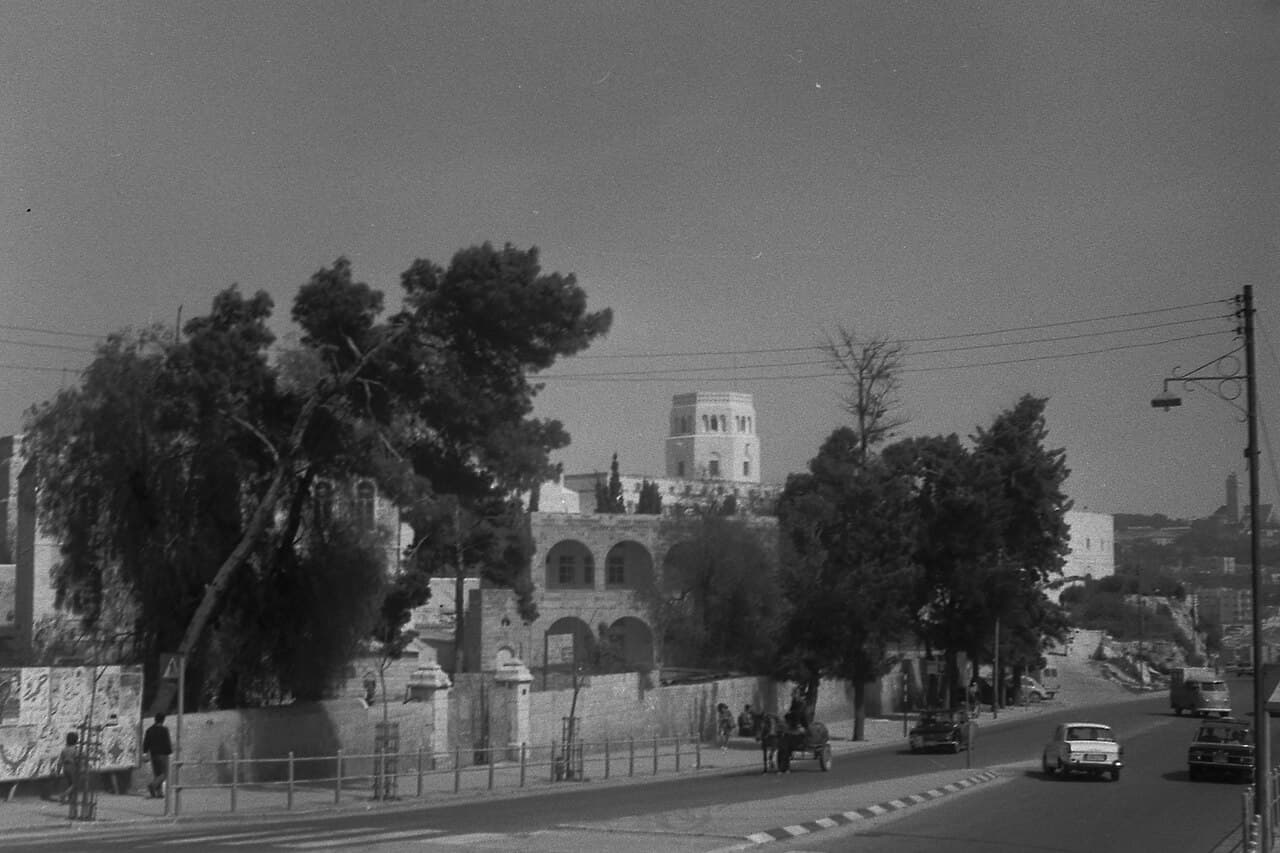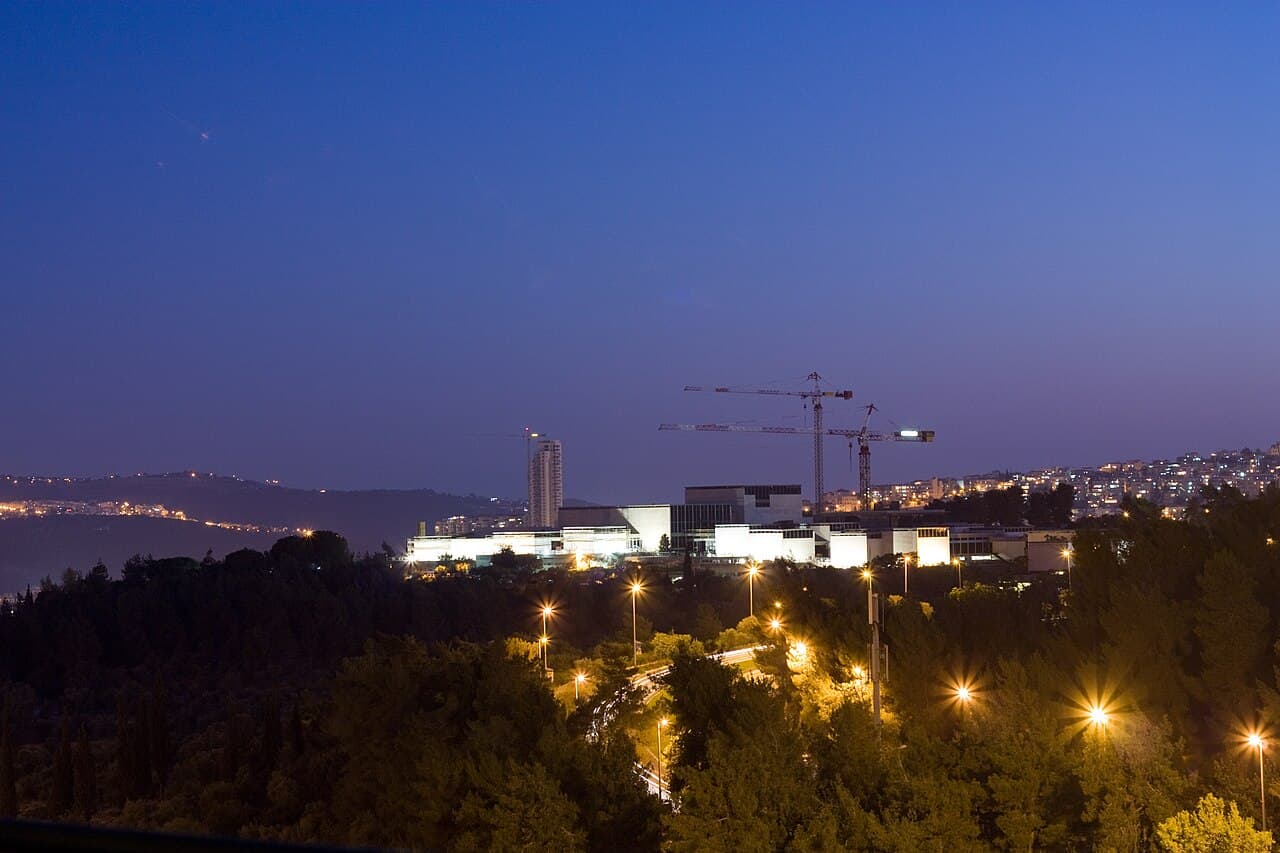
Givat Ram is often treated as the space between attractions: leave a bus, enter the Knesset, cross to the National Library, continue toward the Israel Museum. The district becomes more revealing when the movement itself is the subject. Law, memory, art, landscape and state ceremony occupy separate compounds whose entrances, setbacks, security thresholds and public routes express different ideas of access.
This is an architecture walk in the sense of reading relationships, not collecting interiors. Some buildings require reservations and identification; some pages are difficult to access from outside networks; security conditions can change. The public realm still offers a serious question: how does an institutional capital make authority visible while deciding how close the public may come?
At a glance
Start here
- Read setbacks, approaches and checkpoints as architectural evidence.
- The Knesset's design history includes competition and controversy.
- The National Library introduces a newer civic threshold to the district.
- Noguchi's art garden turns landscape into an institutional edge.
01
Begin with thresholds, not facades
Before naming styles, notice the sequence from pavement to entrance. Is there a garden, wall, forecourt, ramp, checkpoint or broad stair? Can the destination be seen before it can be entered? Public architecture always manages a contradiction: an institution may represent citizens or preserve shared culture while protecting people, collections and official work from unrestricted access.
In Givat Ram that contradiction repeats at different scales. The Knesset publishes security and identification conditions for tours. The National Library markets public architecture, exhibitions and guided routes while separating reading-hall access. The Supreme Court maintains a public reception and tour coordination service. These are not equivalent permissions, but together they make the district's graduated access legible.
Sources: The Knesset; National Library of Israel; State of Israel Judicial Authority02
The Knesset began with a design debate
The Knesset's official building history places the architectural competition in 1956 and the selection of Joseph Klarwein's proposal in 1957, followed by a cornerstone ceremony in 1958. It also records controversy and later collaboration in the path to the completed building. That institutional account matters because it refuses the fantasy that a national parliament arrived as an uncontested, fully formed symbol.
Read the building as the outcome of negotiation among programme, representation, money, designers and critics. Its visual order can suggest permanence, yet its origin story is procedural and argumentative. From public space, observe how the long horizontal mass, columns, landscape and controlled approach distribute importance. Do not infer access from visibility: the current tour page requires prior compliance with identification and security rules and allows changes or cancellation.
Sources: The Knesset; The Knesset03
The National Library changes the civic triangle
The National Library's history page says its new building opened in 2023 between the Knesset and the Israel Museum and identifies Herzog & de Meuron as designers. That placement is an urban statement: the stewardship of texts and archives is given a monumental address beside legislative and museum institutions rather than hidden inside a university stack.
The library's architecture-tour material credits Herzog & de Meuron with Mann Shinar and frames the design through apparent opposites including stability and movement. Test those words against what can lawfully be observed: a substantial stone-like volume, openings, shaded approaches and flows toward public interiors. The exact English pages returned 403 responses during this review, so a tour or interior visit must be confirmed independently.
Sources: National Library of Israel; National Library of Israel04
Noguchi makes landscape an institution
At the Israel Museum, the Billy Rose Art Garden complicates the idea that architecture ends at a wall. The museum describes Isamu Noguchi's design as an environmental sculpture joining landscape, nature and art. It opened with the museum in 1965 and extends along the museum's western edge toward Givat Ram. Ground, horizon, path and sculpture become one spatial composition.
The official Oasis exhibition, scheduled through 2 January 2027, revisits the garden's creation for its sixth decade. Its language of contemplation and the meeting of East and West should be read as the museum's curatorial framing, not a neutral description of Jerusalem. Walk slowly enough to notice how terraces and stone organise sightlines, but verify admission and garden access because the general visitor page did not render in the research browser.
Sources: The Israel Museum, Jerusalem; The Israel Museum, Jerusalem05
The court makes approach part of judgment
The Supreme Court's official public-reception page locates the court at Sha'arei Mishpat 1 in Kiryat Ben-Gurion and provides a route for coordinating tours. Even without claiming details that the service page does not document, its presence expands the district's institutional programme: legislature, national collection, museum and highest court occupy a connected civic landscape.
Observe the court from permitted public routes through sequence rather than symbolism imposed from a guidebook. Where does the path turn? When does the entrance become visible? Which spaces invite a pause, and which direct a visitor toward screening? If an official tour is available, compare the public approach with the internal route. If it is not, the exterior relationship still supports careful observation without trespass.
Sources: State of Israel Judicial Authority06
Walk the intervals as seriously as the sites
The distance between institutions contains the district's argument. Roads, crossings, planted areas, fences and open ground decide whether civic neighbours feel connected. Look back as you move: a building designed as a frontal monument may behave very differently from the side, while a library opening can redirect an older pedestrian route. Photograph only where permitted and exclude guards, checkpoints and security equipment.
Do not turn the walk into a race around a triangle. Select two institutions and one landscape edge, then sit long enough to sketch their relationships in words. Note materials without pretending to identify every stone. Note who can rest in shade, where a wheelchair route diverges, and which entrance information is visible before a visitor reaches control. Access is experienced spatially before it becomes a ticket condition.
Sources: National Library of Israel; The Israel Museum, Jerusalem; The Knesset; State of Israel Judicial Authority07
Plan the reading without interior promises
Check each institution separately. The Knesset visitor page may require identification, limits bags and warns that tours can change. The library divides public, exhibition, research and tour access. The museum's general visitor page rendered as an empty JavaScript shell here. The court service coordinates its own visits. None of those channels guarantees the others, and a district-wide opening assumption is unsafe.
Build an exterior route that remains worthwhile if every interior booking fails, then treat confirmed admission as an addition. Carry identification only as official guidance requires and never attempt to bypass screening. Check current government advice and local instructions on the day. The architecture is not diminished by these conditions; the pattern of invitation and control is precisely what the district asks a careful reader to see.
Sources: The Knesset; National Library of Israel; The Israel Museum, Jerusalem; State of Israel Judicial AuthorityUseful answers
Reader questions
Can I enter all the Givat Ram institutions on one walk?
Do not assume so. The Knesset, National Library, Israel Museum and Supreme Court have separate visitor, booking and security systems. Check each exact institution on the day and make the exterior relationships worthwhile on their own.
Sources: The Knesset; National Library of Israel; The Israel Museum, Jerusalem; State of Israel Judicial AuthorityWho designed the National Library's current building?
The library's official history identifies Herzog & de Meuron, while its architecture-tour material also credits Mann Shinar. The building opened in 2023 between the Knesset and Israel Museum; exact English pages returned 403 during this review.
Sources: National Library of Israel; National Library of IsraelIs the Billy Rose Art Garden just a sculpture display?
The museum treats Noguchi's entire landscape as an environmental artwork rather than a neutral container for statues. Its inauguration coincided with the Israel Museum's 1965 opening. Confirm current admission instead of assuming an outdoor setting is freely accessible.
Sources: The Israel Museum, Jerusalem; The Israel Museum, JerusalemDo I need to book a Knesset tour?
Use the Knesset's current visitor channel and comply with its identification, bag and security rules. The page warns that tours may change or be cancelled, so a reservation should not be treated as an unconditional promise of entry.
Sources: The KnessetRead the evidence
Sources and further reading
These sources support the relevant sections above. Plans and comparisons are editorial suggestions. Check operators for current arrangements.
- The Knesset Building Story ↗The Knesset · Accessed 14 September 2026
1956 competition, 1957 Klarwein selection, 1958 cornerstone and design controversy; exact fetch returned status 474.
- Tours of the Knesset ↗The Knesset · Accessed 14 September 2026
Visitor identification, bag and security conditions and possibility of changes; exact page returned an empty shell.
- History of the National Library of Israel ↗National Library of Israel · Accessed 14 September 2026
2023 opening, location between civic institutions and Herzog & de Meuron attribution; exact fetch returned 403.
- Architecture tour ↗National Library of Israel · Accessed 14 September 2026
Herzog & de Meuron and Mann Shinar credits and tour framing; exact fetch returned 403.
- Oasis: Noguchi's Art Garden in Jerusalem ↗The Israel Museum, Jerusalem · Accessed 14 September 2026
Garden designer, environmental-sculpture concept, 1965 opening, Givat Ram orientation and exhibition dates.
- Visitor information ↗The Israel Museum, Jerusalem · Accessed 14 September 2026
Exact official visitor URL and empty JavaScript response observed during review.
- Supreme Court reception of the public ↗State of Israel Judicial Authority · Accessed 14 September 2026
Official location and tour-coordination channel; exact fetch returned 403 during review.